Certified to IEC 60947 & UL 489 standards — Explore Our Testing Protocols →

VoltShield Circuit Breaker Technology

From electronic trip algorithms to arc flash energy limitation — the engineering principles behind measurable, verifiable protection performance.

Electronic Trip Units vs. Thermal-Magnetic

VoltShield VS-M series MCCBs are available with both thermal-magnetic and advanced electronic trip units (ETUs). The choice directly affects protection precision, coordination with upstream/downstream devices, and integration with SCADA and power monitoring systems.

Our ETU-E module implements configurable L-S-I-G protection functions with adjustable time-current curves. The I²t memory function allows thermal memory accumulation to be factored into trip decisions — critical for applications with repetitive starting loads.

For systems requiring Modbus RTU / TCP communication, the ETU-C module provides real-time current measurement (all 3 phases + neutral), energy logging, and pre-alarm outputs before overload trip — enabling predictive maintenance workflows.

Trip Unit Comparison: Thermal-Magnetic vs. ETU
Protection Functions TM: Overload + Short-circuit
ETU: L, S, I, G (configurable)
Adjustment Accuracy TM: ±20% (temperature-dependent)
ETU: ±5% (temperature-independent)
Selectivity Support TM: Current-based only
ETU: Current + time-based (zone)
Communication TM: None
ETU-C: Modbus RTU/TCP, IEC 61850
I²t Memory TM: Bimetallic inherent
ETU: Configurable software-based
Typical Application TM: Standard distribution boards
ETU: MCC, data centres, industrial plants

Arc Flash Energy Limitation

Arc flash incidents release explosive thermal energy. IEC 62271-200 and IEEE 1584 define the incident energy levels (cal/cm²) that determine required PPE categories for electrical workers. Reducing incident energy at the source — through faster fault clearing and current limitation — is a primary VoltShield design objective.

The VS-M series MCCB achieves arc energy limitation through:

Current-Limiting Contacts

Electromagnetic repulsion mechanism initiates contact opening within the first half-cycle, limiting peak let-through current (I²t) to values 60-80% below non-current-limiting devices of the same rating.

Zone Selective Interlocking (ZSI)

ETU-C modules support ZSI: only the breaker closest to the fault trips at minimum delay, while upstream devices maintain selectivity — reducing fault clearing time to <50ms.

Maintenance Mode (High-Speed Trip)

Optional maintenance mode via ETU reduces instantaneous pickup to near-zero delay when workers are performing live-adjacent tasks — incident energy reduced below 1.2 cal/cm².
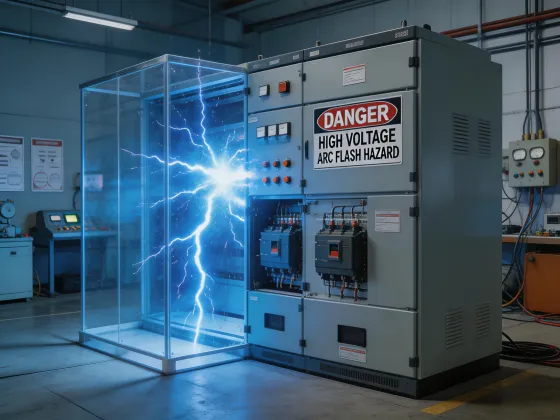
Arc Flash Mitigation Testing

IEC 60947 Type Testing Protocol

Every VoltShield MCCB series undergoes complete IEC 60947-2 type testing at accredited third-party laboratories. Test reports are available for customer review upon NDA.

Breaking Capacity (Icu / Ics)

Ultimate (Icu) and service (Ics) short-circuit breaking capacity tests at rated voltage. VS-M series achieves Ics = 100% Icu across all current ratings — no service derating.

Up to 50kA @ 400V AC

Mechanical / Electrical Endurance

Utilisation category A and B mechanical operation cycles per IEC 60947-2. VS-C MCB: 20,000 mechanical + 6,000 electrical operations without degradation.

20,000 Cycles Endurance

Dielectric Strength & Insulation

Power frequency and impulse dielectric tests per IEC 60947-1 insulation coordination. Rated insulation voltage Ui = 1000V, rated impulse withstand Uimp = 8kV.

Uimp = 8kV

Temperature Rise

Terminal and contact temperature rise testing at rated current for 8 hours. Derating curve data provided for elevated ambient temperatures up to +60°C.

-25°C to +70°C Operating Range

Selectivity & Coordination

Proper selectivity (discrimination) between upstream and downstream circuit breakers ensures that only the faulted circuit disconnects — critical for minimising disruption in industrial and data centre environments.

VoltShield provides selectivity tables (total, partial, and energy-based) for all VS-C/VS-M series combinations. Our technical team can verify your proposed coordination scheme against our published data.

Supported Selectivity Methods:

  • Current selectivity (time-overcurrent coordination)
  • Time selectivity (graded time delays on ETU-E/ETU-C)
  • Zone Selective Interlocking (ZSI) via ETU-C signal wire
  • Energy-based selectivity (back-up protection with cascading)
  • Logic selectivity (SCADA-assisted trip logic)
VS-C / VS-M Selectivity Reference Data
VS-C 63A + VS-M 400A (TM) Total selectivity up to 18kA
VS-C 63A + VS-M 400A (ETU-E, tsd=100ms) Total selectivity up to 36kA
VS-M 400A + VS-M 1600A (ZSI) Total selectivity up to 50kA
Energy let-through (I²t) at 25kA / VS-M 250A <3.2×10⁶ A²s
Short-circuit withstand (Icw) VS-M 630A 30kA for 1s / 50kA peak

Technical Downloads

Submit an inquiry to receive product-specific datasheets, type test reports, and selectivity tables.